
Module 1F: Capabilities of Lenses
F. Capabilities of Lenses
Depth of Field
Depth of field (DOF) is defined as the area in a photograph that will be in acceptable focus. The depth of field determines the relative sharpness or lack of sharpness in the background (and the foreground) in relation to the subject.
Depth of field is a measurable distance. Approximately one-third of the total distance extends forward toward the camera at the point of focus and two-thirds extend behind the point of focus. For example, with a subject focused at 10 feet with a 9ft depth of field, the photographer can anticipate relative sharpness between 7 to 16 feet (3ft in front, 6ft in back).
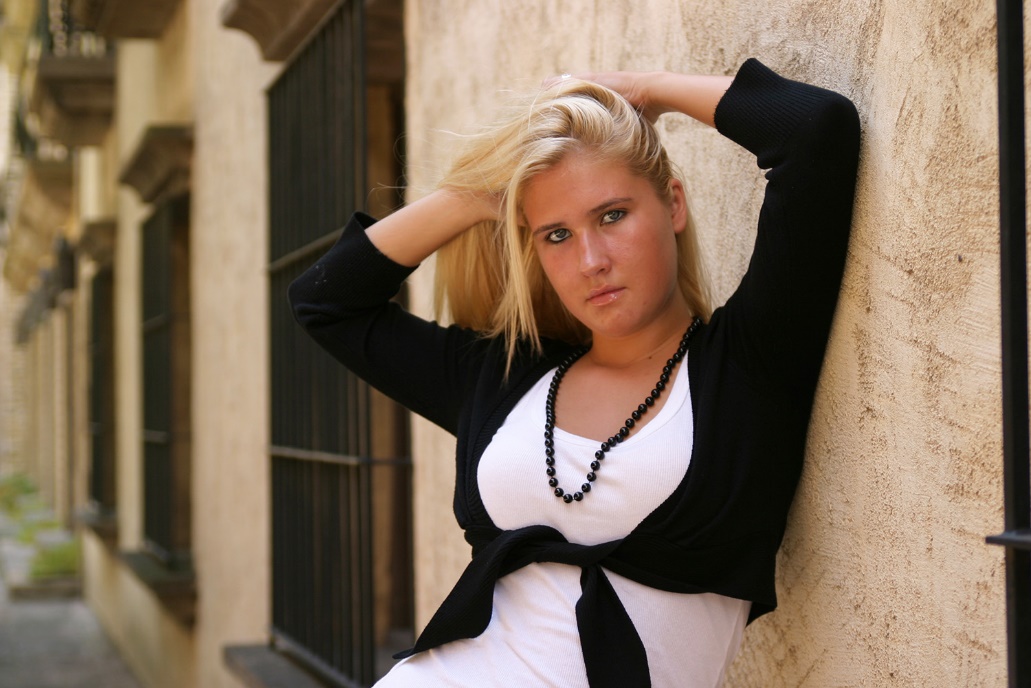
Shallow Depth of Field
A shallow DOF means that the background and the foreground will appear more out of focus.
The image above (taken at f/2.8) has a shallow depth of field. Notice how the background is quite out of focus.
This technique allows the photographer to place the emphasis on the subject without distractions from the background.
Large Depth of Field
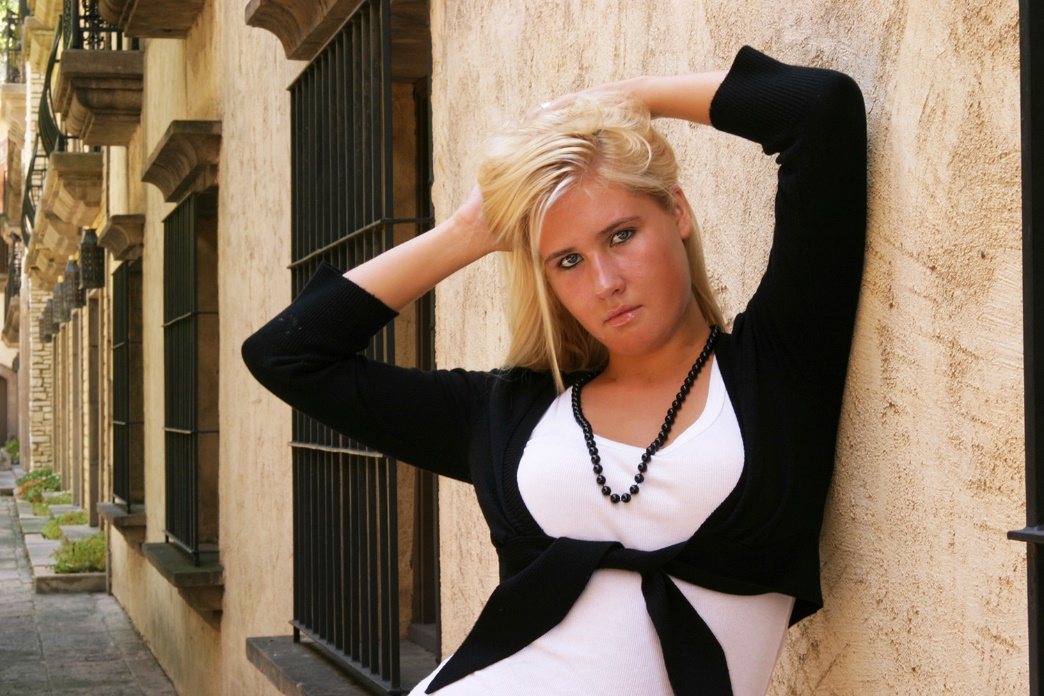 With a large DOF, the background and the foreground appear sharper or more in focus.
The image above with the same subject and composition, taken at f/16, has a much larger depth of field. A larger depth of field is useful when elements in the background are used as part of the overall composition.
Controlling the depth of field allows the photographer to soften or sharpen the background to the degree that is desired for the specific image. A shallow depth of field helps to put emphasis on the subject and may help to eliminate unwanted distractions.
Three Factors that Influence Depth of Field
The three factors that control depth of field at image capture are:
· F-stops
· Camera-to-subject distance
· Focal length of the lens
F-Stops
The f-stop, or aperture, is the mechanism inside the lens that opens up or stops down to control the amount of light that reaches the film or sensor.
The whole f-stops are:
1.4 2 2.8 4 5.6 8 11 16 22 32

The f-stops not only control the amount of light that reaches the sensor, but they also control depth of field.
The larger the lens opening, the shallower the DOF.
The smaller the lens opening, the greater the depth of field.
Focal Length
There are inherent tendencies in lens selection to depth of field.
The longer the focal length of the lens, the shallower the DOF.
The shorter the focal length of the lens, the greater the DOF.
Camera-to-Subject Distance
The camera-to-subject distance has a pronounced impact on depth of field.
The closer the camera is to the subject, the shallower the DOF.
The further the camera is from the subject, the greater the DOF.
Controlling Distortion
There are different types of distortion caused by different lenses. Some distortions are useful to the photographer and can be used to help convey the story the photographer wishes to tell.
Other types of distortion can be a nuisance, and the photographer will need to know various ways to eliminate or minimize the distortion caused by specific lenses.
Convergence
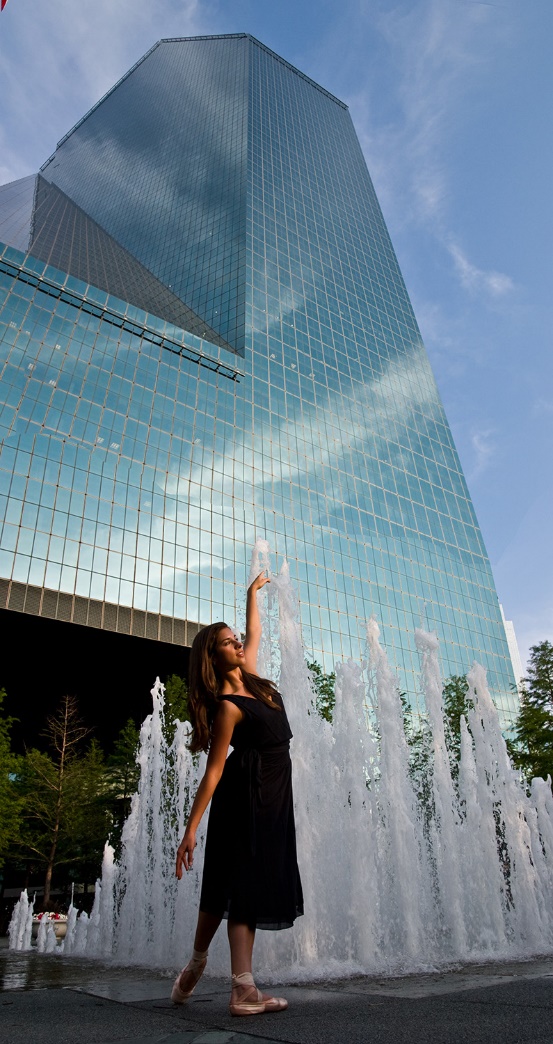
Tilting the camera upward to photograph a tall building tends to exaggerate the building as wider at the bottom and narrower at the top. This effect is known as convergence or keystone. This effect is exaggerated with a wide-angle lens. This problem is not a distortion caused by the lens but is actually a distortion of perspective.
To minimize this effect, the photographer must control the camera perspective and keep the sensor parallel to the building. This requires creating enough distance from the building to capture the entire building from top to bottom without tilting the camera upward.
In the image on the right, the subject’s location in relation to the building and the fountain made it impossible to capture the entire building without the camera tilting upwards. The result is the convergence of the lines of the building at the top.
This problem can be remedied with a view camera or tilt-shift lens that can control perspective. A tilt-shift lens can be shifted upward while leaving the camera, and therefore the sensor plane, parallel with the subject. This can also be done easily on traditional view cameras as they also have the ability to tilt and swing while keeping the film plane parallel to the subject.
Another way to control this distortion is in an image editor such as Photoshop.
Camera Angle
To minimize subject distortion, the position of the camera is relative to the subject height.
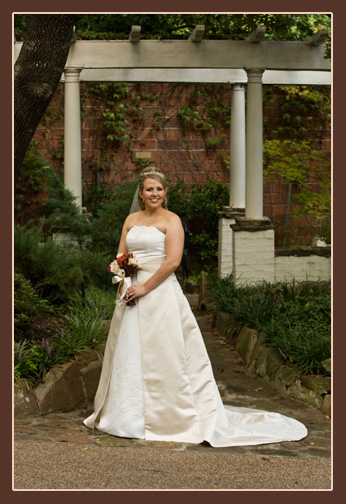
For a full-length pose, the camera should be placed near the level of the subject’s waist and the lens should be level with the ground.
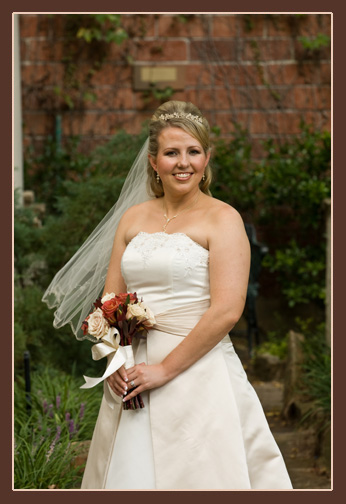
For standing poses cropped to a 2/3 length, position the camera near the level of the subject’s chest and with the lens level to the ground.
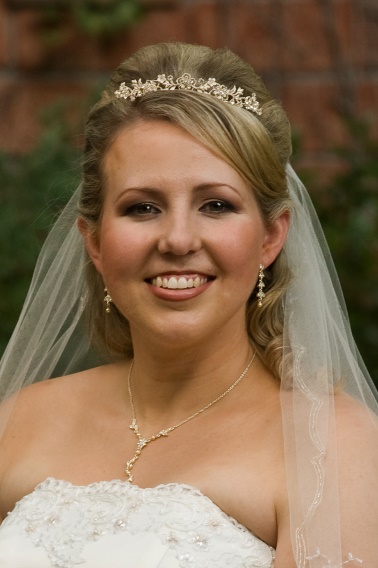
For head and shoulders poses, position the camera slightly above the subject’s chest level and with the lens level to the ground.
Hyperfocal Distance
To maximize the sharpness of the background, photographers will sometimes manipulate the point of focus in order to take the focus of the background to infinity. By definition, hyperfocal distance is the closest distance of focus in which a lens will keep objects at infinity acceptably sharp. The hyperfocal distance provides the photographer with a point of focus to achieve the largest possible depth of field by keeping infinity within the furthest range of a given f-stop.
The task of determining this distance was much simpler in the days when lenses had a depth of field scale.
Hyperfocal distance varies with each focal length, f-stop and sensor size, so it is much easier to use a Depth of Field Calculator.
The idea is to increase the depth of field by actually focusing past the subject while ensuring that the subject remains in the area in front of the point of focus and still appears sharp.
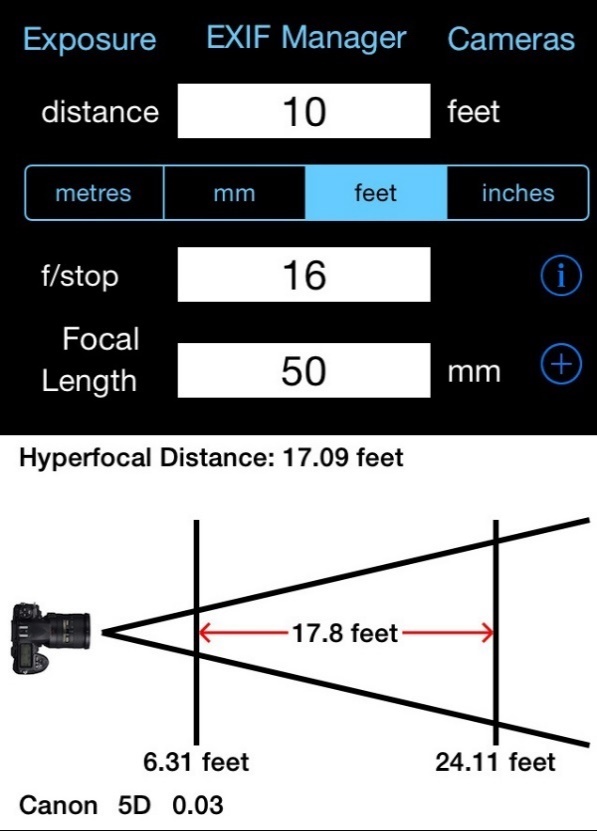
For example, with an image exposed with a 50mm lens at f/16 using a full frame sensor, the subject at 10ft has a depth of field of 17.8ft. (left)
The result shown on the chart indicates a total depth of field of 17.8ft and the elements which are between 6.3ft and 24.1ft would be in acceptable focus. It also reveals the hyperfocal distance to be 17.09ft.
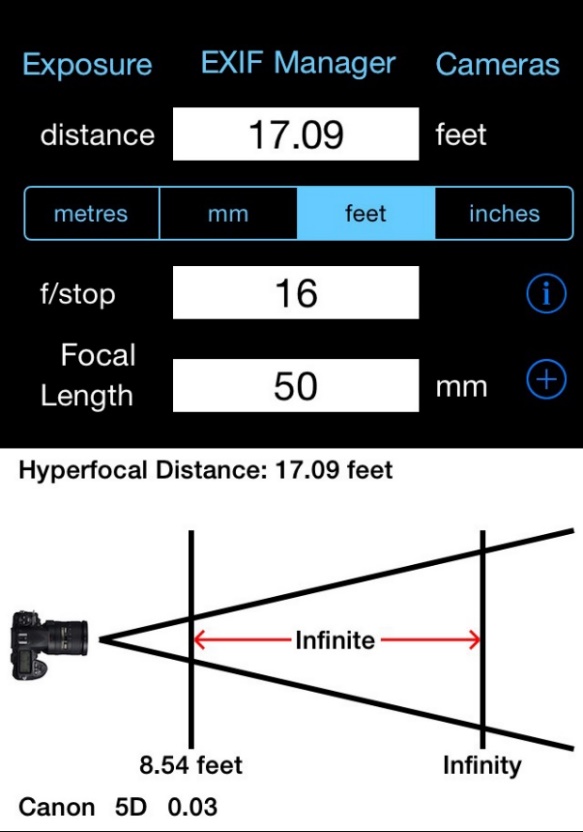
Knowing that the subject is at 10ft, we can use the app to input the resulting hyperfocal distance of 17.09 and see the change in depth of field. (above)
Now we can see that the nearest point of acceptable focus is at 8.54ft, and the background focus has increased from 24.11ft to infinity. That is an infinite gain in depth of field! Also notice that the subject at 10ft is still within the range of acceptable focus.
This technique is quite popular among landscape photographers, but it also has applications for all types of photography.
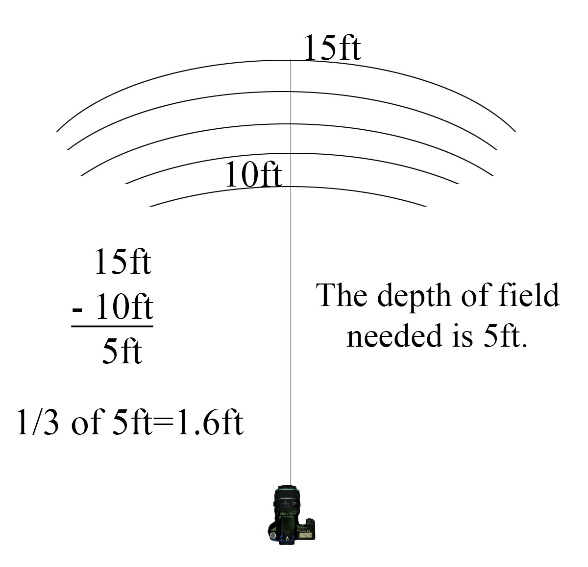
For example, let’s look at photographing a choir that is arranged in 5 rows using a full frame sensor and a 50mm lens at f/5.6
The front row is 10ft from the camera and the back row is 15ft from the camera.
If you calculate the difference in the distance between the two rows, you get 5ft. We are looking for a DOF of at least 5 feet to keep the front and back rows sharp.
We know 1/3 of the DOF comes forward and 2/3 goes backward, so a depth of field of 5ft has 1.6ft in front and 3.4ft in back.
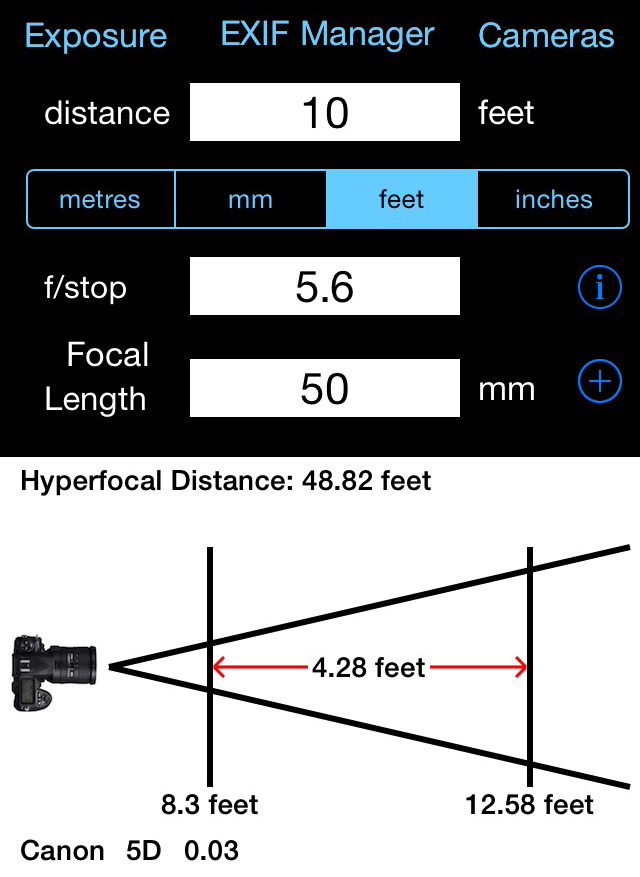
Using the DOF app above, we can see that f/5.6 focused on a subject at 10ft only provides 4.28ft of DOF and only 2.58ft of that is going behind the first row. The result would be that the back two rows will not be sharp.
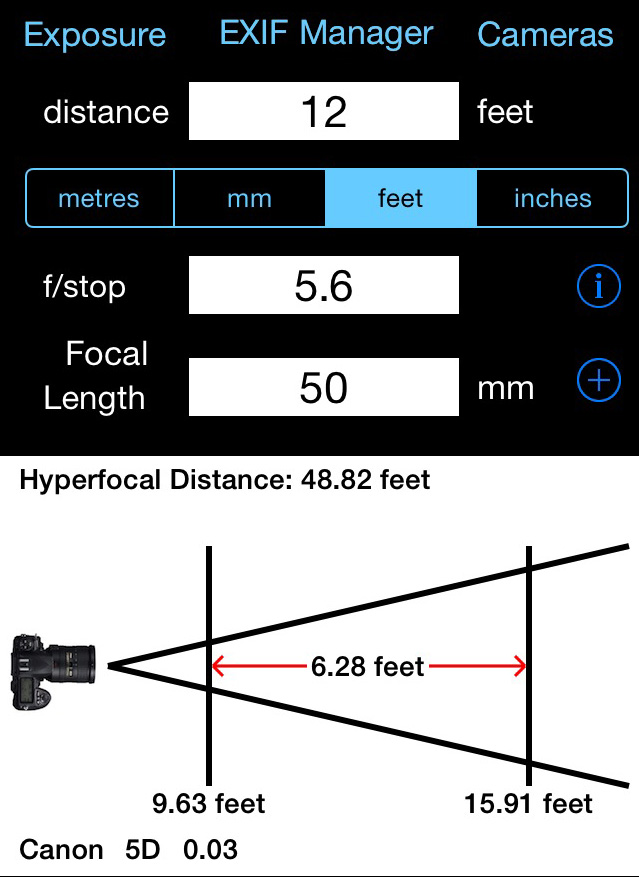
Using hyperfocal techniques, we can change the point of focus to 12ft and the first row of the choir at 10ft is within range (9.63ft) and the back row at 15ft is within range (15.91ft). (above)